
Whitby’s Memorials had a good problem. The business was capable of taking on larger restoration and memorial projects, but its blasting process was the limiting factor.
The existing set-up worked, but it no longer matched the scale of work the company wanted to handle or the efficiency it needed from its production process.
For the long-established, family-run memorial business, the question was not simply whether to buy a bigger blast machine. It was whether the blasting process itself needed to be rethought.
That is where SurfacePrep UK became involved.
Rather than starting with a product, SurfacePrep worked with Whitby’s to understand how the business operated, the range of work being processed, the available space and where the existing system was creating restrictions. The result was a bespoke 20ft containerised blast room designed around the way Whitby’s actually works.
Starting with the problem, not the machine
One of the strongest aspects of the project was the work carried out before anything was manufactured. SurfacePrep did not arrive with one predetermined blast room and try to make it fit. Following discussions with Whitby’s and a visit to Hodge Clemco, three potential solutions were developed:
- A 10ft containerised blast booth
- A 20ft containerised blast booth with a dedicated plant room
- A purpose-built acoustic blast room
Each option incorporated the same core requirements, including pressure blasting, abrasive recovery and cleaning, dust extraction, internal lighting, floor protection, rubber lining, a viewing window and glove ports.
The decision was therefore not simply, “Which machine should Whitby’s buy?”
It was, “Which overall configuration best suits the way Whitby’s needs to work?”
That shift from product selection to process design is central to SurfacePrep’s consultative approach.
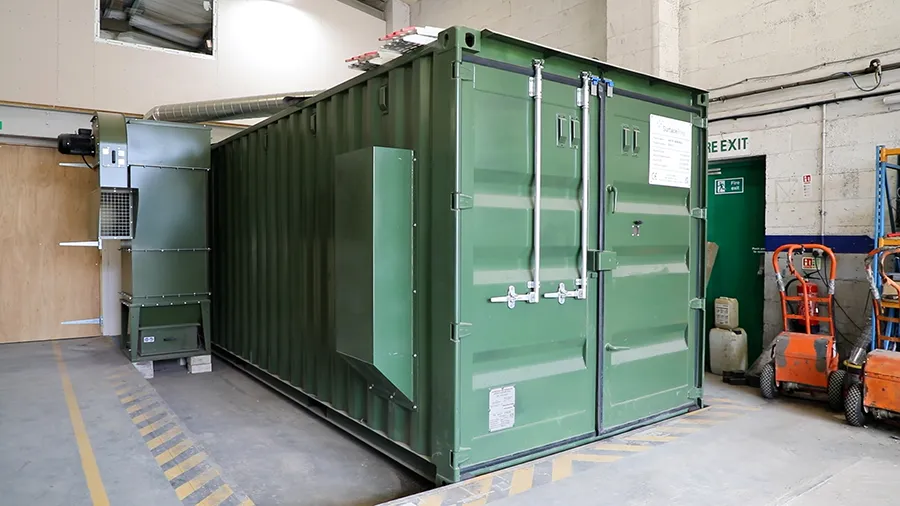
Why the 20ft containerised system made sense
The chosen 20ft configuration gave Whitby’s two different ways of working from one system. The weatherproof enclosure is approximately 6.1 metres long, 2.5 metres wide and 2.5 metres high. Around 3.7 metres is dedicated to the blasting area, with the remaining space used as a plant room for the blast machine and abrasive recovery equipment.
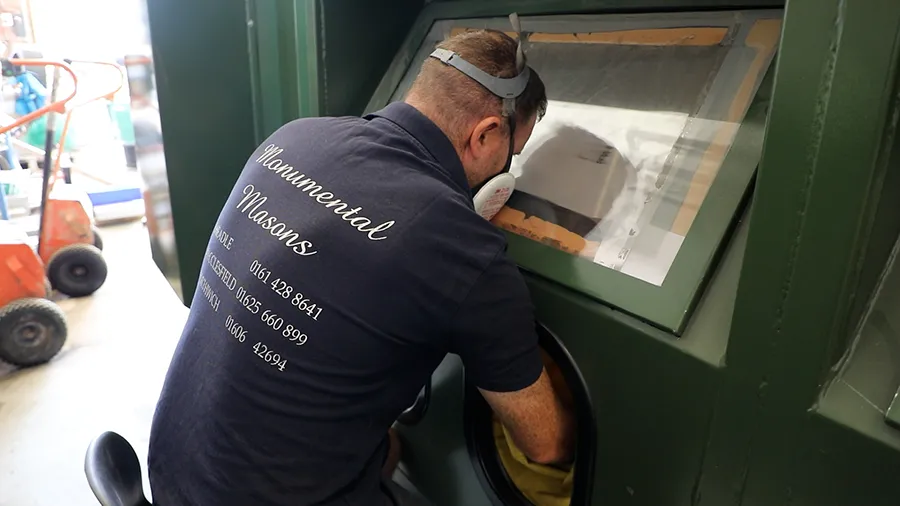
A large viewing window and twin glove ports allow smaller work to be blasted without the operator entering the room. For larger memorials and stonework, the end doors provide access to the walk-in blasting area.
That flexibility is important because Whitby’s is not processing one standard component in one standard way. The same system needs to cope with smaller, controlled work and much larger restoration projects.
John Hulme, Managing Director of Whitby’s Memorials, has already seen the commercial benefit:
“I’ve been really pleased with our container blast from SurfacePrep. It’s allowed us to do bigger jobs and it’s a lot faster.”
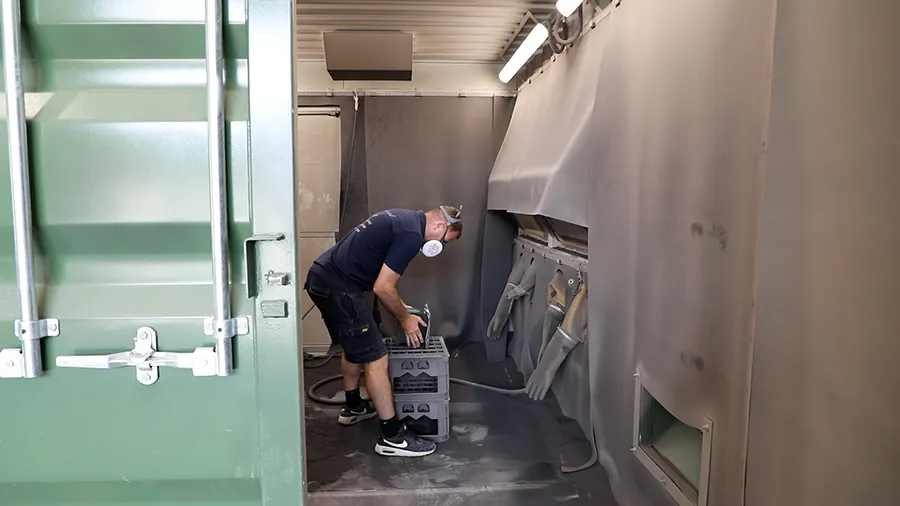
More control over the blasting process
At the heart of the system is a 2040 industrial direct-pressure blast machine. The specification includes accurate abrasive metering and variable pressure control, giving the operator greater control over how the blasting process is applied. This matters for Whitby’s because memorial and restoration work can vary considerably.
The requirement is not simply more blasting power. It is the ability to adjust the process to suit the work in front of the operator.
The 2040 provides the capacity required for more demanding work while giving the team control over pressure and abrasive flow.
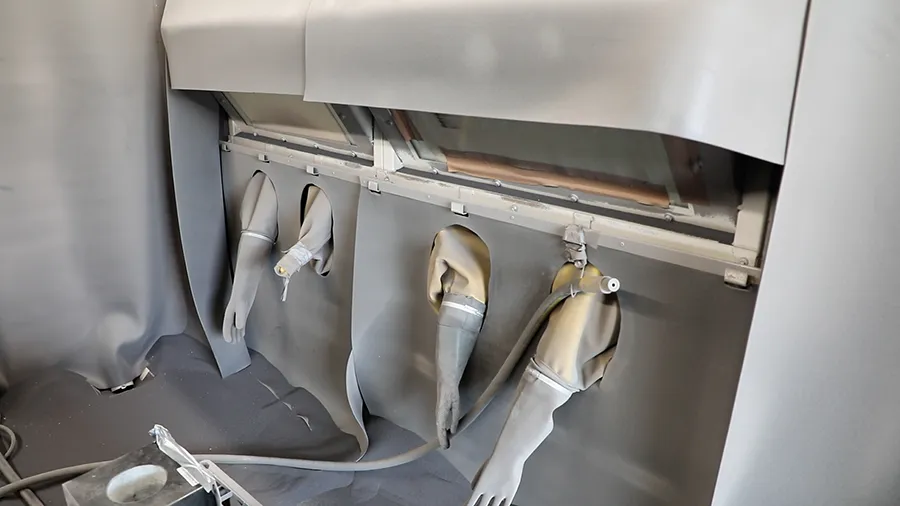
Removing a hidden production bottleneck
A major improvement is the way abrasive is handled. Without an effective recovery process, operators can spend time collecting spent abrasive, handling it and replenishing the blast machine. Whitby’s new installation incorporates an IND200P abrasive recovery, storage and grit-cleaning system.
Spent abrasive is swept into a floor hopper and transported by vacuum to the storage silo. Reusable media is separated from dust, fines and oversized contamination before being retained for reuse. For the operator, the benefit is very practical. John explains:
“We don’t have to load the blaster manually now using the extraction system, which is great from a health and safety point of view.”
The value is not automation for its own sake. It removes unnecessary handling from a repetitive part of the process and allows operators to spend more time on productive work.
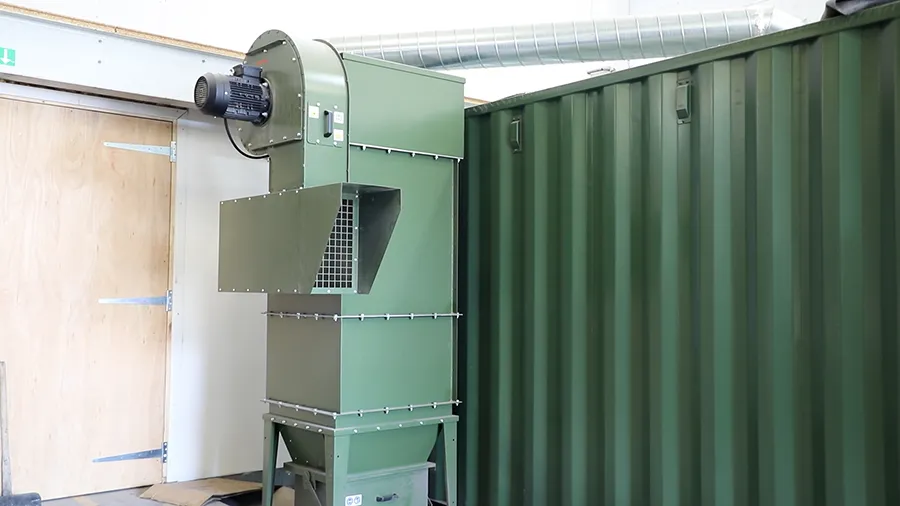
Extraction and installation designed into the system
The blast room also incorporates a 3,400 m³/hr reverse-pulse dust extraction system. Rather than treating extraction as an add-on, it was designed as part of the overall blasting process. The system removes airborne dust from the booth while reverse-pulse cleaning helps maintain filter performance.
SurfacePrep’s own blast-room guidance highlights the importance of correct airflow, filtration and dust collection in maintaining an effective blasting environment. The containerised design also helped simplify installation.
The sweep-in recovery system was integrated without the need for civil works for the recovery hopper, reducing the amount of site modification required.
SurfacePrep’s scope included installation, commissioning and basic operator training, meaning Whitby’s received a complete working system rather than individual pieces of equipment that still needed integrating.
The operational change
The real measure of the project is not the technical specification. It is what Whitby’s can now do that was harder to do before. The business has greater flexibility over the size of work it can process, a faster blasting operation and less manual abrasive handling.
Just as importantly, the project has created room for future growth without the blasting process becoming the immediate restriction. John’s view of the experience is equally clear:
“I highly recommend SurfacePrep, they’ve been very, very easy to deal with. Very prompt when you want them to come out, they’re there the day later.” That customer evidence says more than a claim about service ever could.
SurfacePrep did not simply supply Whitby’s with a larger blast machine. It worked through the constraint, considered alternative configurations, engineered the right combination of equipment, installed and commissioned the system, and provided Whitby’s with a blasting process better suited to where the business is going next.
Whitby’s did not just upgrade its blasting equipment. It removed a production constraint and created capacity for bigger work.
Is your blasting process becoming the bottleneck?
A larger blast machine is not always the answer.
The real restriction may be enclosure size, abrasive handling, recovery, extraction, access or the way the individual parts of the process work together.
Speak to SurfacePrep about your current blasting process and where the bottlenecks are.