
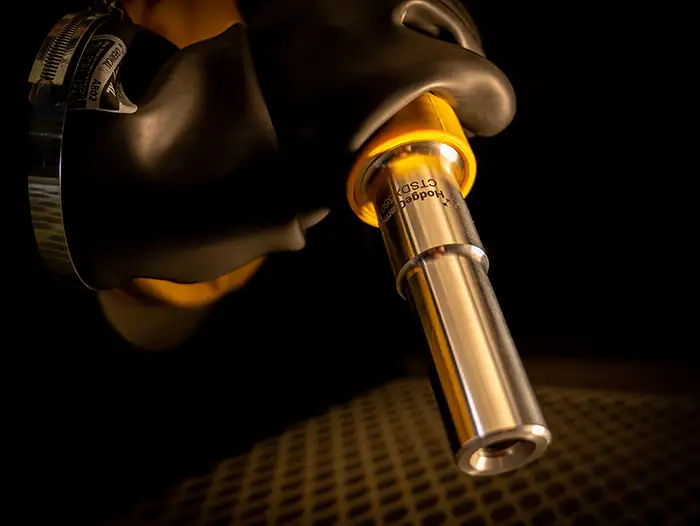

Are You Using the Right Blast Nozzle?
Discover how PSI, CFM and nozzle material impact performance, wear and running costs, and choose the right solution for your application.
Most teams treat a blast nozzle as a simple consumable, replace it when it’s obviously worn, move on.
That mindset is expensive, because the nozzle isn’t just “the bit on the end”. It’s the control point that determines:
- how much compressed air you burn
- how much abrasive you throw
- how consistent your blast pattern stays
- how often production stops for unplanned changes and knock-on maintenance
If you care about throughput, finish quality, and predictable cost per hour, nozzle efficiency is where you start.
What “blast nozzle efficiency” actually means in production
In practical terms, an efficient nozzle is one that achieves the required cleanliness and profile:
- with the lowest sustainable air and abrasive consumption
- with the most consistent blast pattern
- with minimal downtime and minimal operator compensation
The problem is that nozzles rarely fail in a dramatic way. They drift. As wear progresses, the orifice opens up and the process quietly becomes more expensive while often producing a worse, less consistent finish.
The commercial trap: you can be paying more per hour and still missing throughput targets, because the process becomes unstable and operators start compensating.
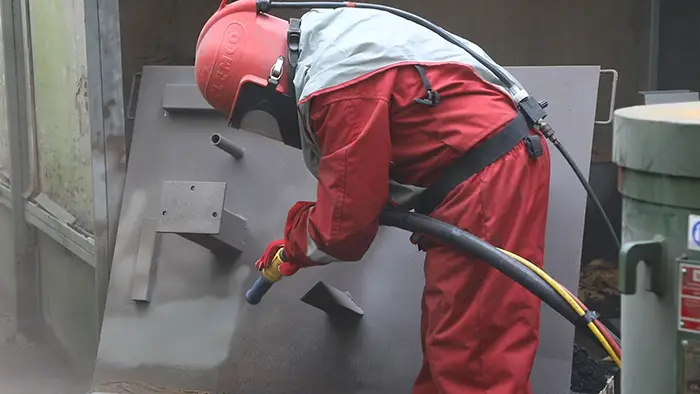
The real nozzle equation: orifice size × PSI × CFM
A nozzle’s performance and lifespan are heavily shaped by two operating conditions:
- Pressure at the nozzle (PSI)
- Air volume moving through the nozzle (CFM)
Put simply, more pressure and more air volume typically increases cutting power, but it also increases wear.
That matters because wear changes the size and behaviour of the nozzle. The orifice opens up, air and abrasive consumption climbs, and the blast pattern becomes less controlled.
You end up spending more to get a worse and less predictable result.
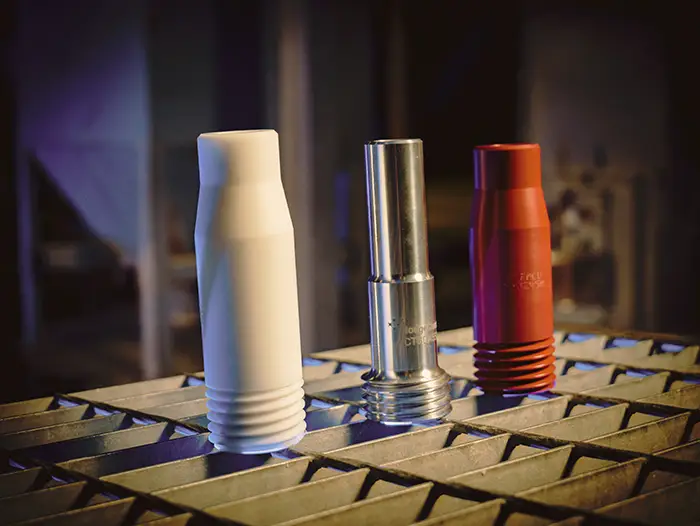
Why nozzle size is a commercial decision, not a technical detail
The nozzle you choose determines your running cost profile.
The reference table in the source material shows compressed air requirements and abrasive consumption across nozzle orifice sizes at different pressures. The takeaway is blunt:
Small changes in nozzle size can create big changes in running cost.
What the table looks like at 100 PSI (illustrative from your source)
- 1/4" nozzle (No.4): ~81 CFM, ~494 lb/hr abrasive
- 3/8" nozzle (No.6): ~196 CFM, ~1152 lb/hr abrasive
- 1/2" nozzle (No.8): ~338 CFM, ~2024 lb/hr abrasive
This is the point most people miss.
The question is not “which nozzle gives the fastest blast”.
It’s: Do you have the air supply to run it properly, and is the extra consumption buying you a better outcome?
If the compressor cannot genuinely support the nozzle, the process becomes unstable. That typically shows up as inconsistent finish, more touch-up, and operators compensating in ways that accelerate wear and reduce control.
PSI, the quickest way to shorten nozzle life
When production slips, the easiest lever to pull is pressure. Turn PSI up, get more aggression, and hope you get your hours back.
There is a predictable consequence: increased PSI generally increases wear because abrasive impacts the nozzle with greater force.
Example lifespan trade-off (tungsten carbide, from your source)
- ~300 hours at 90 PSI
- ~200 hours at 120 PSI
This is the decision to make explicit to any production manager:
If you increase PSI to hit a short-term target, you may be choosing more frequent nozzle changes, more downtime, and a less stable process in the medium term.
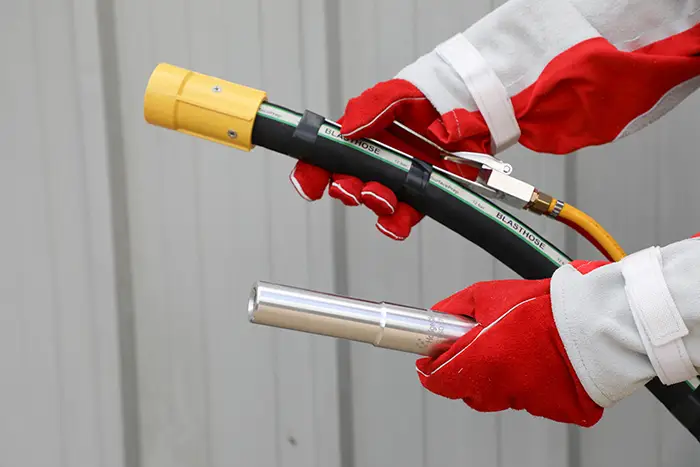
CFM, the silent contributor to wear (and cost)
CFM rarely gets the same attention as PSI, but it should.
Higher CFM usually increases abrasive velocity and accelerates nozzle wear, because more air and abrasive volume passes through the orifice .
Example lifespan trade-off (from your source)
- ~300 hours at 350 CFM
- ~200 hours at 450 CFM
The practical implication is simple:
If you are chasing performance, do it with control, not brute force.
Aim for the lowest PSI and CFM that still hits the required cleanliness and profile, then stabilise the process around that.
That stabilisation is where throughput lives.
Nozzle materials: what the lifespan numbers really tell you
Material choice is where buyers often make an avoidable mistake, they optimise for unit price instead of lifecycle cost.
Lifespan guidance:
- Ceramic: ~20–40 hours
Good for small, intermittent work where low purchase price matters more than changeover time. - Tungsten carbide: ~200–300 hours
A common industrial “workhorse” that balances durability and cost. - Silicon carbide: ~300–400 hours Hard, wear-resistant, lightweight, and thermally stable where longevity matters.
- Boron carbide: ~700–1000 hours
Highest durability listed, higher price, often justified when downtime is expensive.
The conclusion is not “always buy boron carbide”.
It’s this: Your nozzle is a downtime decision.
If nozzle changes interrupt production, introduce quality variation, or increase safety risk during hurried changeovers, the cheapest nozzle often becomes the most expensive option.
The simplest cost model to justify the right nozzle
If you want this to land with commercial decision makers, give them a basic way to think.
A nozzle affects four cost buckets:
- Air cost: rising CFM demand and compressor load
- Abrasive cost: media consumption climbs with nozzle size, PSI, and wear drift
- Downtime cost: nozzle swaps, stoppages, knock-on maintenance
- Quality cost: rework, inconsistent finish, rejected parts, operator compensation
Even if you don’t publish exact £ figures, this model makes the argument defensible: nozzle choice is not “maintenance”, it’s operational economics.
A practical blast nozzle efficiency checklist (operator-proof)
Use this as a quick control system for better performance and lower cost per hour.
- Match nozzle size to available air supply
Confirm what air you can deliver at the nozzle, not what the compressor is rated for on paper. If supply cannot support the nozzle properly, stability will suffer. - Run the lowest effective PSI and CFM
High PSI and high CFM can feel productive, but they accelerate wear. Set targets based on required cleanliness and profile, then standardise. - Inspect nozzles routinely, don’t wait for obvious failure
Worn nozzles drift. Replace before wear affects finish quality, pattern control, or starts damaging other components. - Choose nozzle material based on the real cost of downtime
If stoppages are expensive or quality is sensitive, pay for longevity. If work is intermittent, lower-cost materials may be rational. - Treat rising abrasive usage as a warning signal
If you’re consuming more media to get the same result, the nozzle may already be drifting, even if it “looks fine”.
Are You Using the Right Blast Nozzle?
Discover how PSI, CFM and nozzle material impact performance, wear and running costs, and choose the right solution for your application.
The bottom line
Blast nozzle efficiency is one of the fastest ways to reduce blasting cost per hour without compromising quality.
Get the nozzle size and material right for your air supply and duty cycle, keep PSI and CFM controlled, and replace nozzles before they distort the process.
That is how you protect throughput, finish consistency, and total running cost.
Blast nozzle efficiency FAQs
What is blast nozzle efficiency?
It’s how effectively the nozzle achieves the required finish with stable performance, minimal air and abrasive waste, and minimal downtime.
Does a bigger nozzle always increase throughput?
Not if your air supply cannot support it. Undersupplied nozzles often create instability and inconsistent finish, which can reduce real throughput.
What wears a nozzle fastest, PSI or CFM?
Both contribute. Higher PSI increases impact force, higher CFM increases volume and velocity through the nozzle, both typically shorten lifespan.
Is boron carbide always worth it?
Not always. It is often justified when downtime is expensive or finish consistency is critical. For intermittent work, a lower-cost nozzle may make sense.
How do I know a nozzle is drifting before quality drops?
Rising abrasive consumption, increasing air demand, reduced pattern control, and operators compensating are common early signals.