When blasting costs start rising, the price of abrasives is often the first place people scrutinise. While understandable, it’s often the wrong place to start.
In most real production environments, cost per part is driven less by the price per bag of media and more by what happens inside the process, how long the part takes to blast, how efficiently compressed air is being used, how much media is doing productive work, and how often inconsistency creates rework.
That’s why two sites can buy similar abrasive at a similar price and still end up with very different running costs.
If you want to reduce blasting cost per part, the better question is not “what does the abrasive cost?” It’s “what is making this process slower, less stable, or more wasteful than it needs to be?”
Why abrasive price alone is misleading
Abrasive matters, but looking at price alone can push teams into poor decisions.
A cheaper media can become an expensive choice if it slows cleaning, creates unstable surface finish, breaks down too quickly, overloads recovery or extraction, or increases clean-up and rework. Our guidance states “the correct abrasive has to be matched to the machine and process”. SurfacePrep offers sample processing and validation to prove the right setup before purchase.
The same principle applies to nozzles and air. Our guidance on air consumption is that air demand depends on nozzle size, not the blast machine itself. In other words, you do not control running costs by simply owning a particular machine, you control it by how well the whole process is specified and maintained.
That’s the commercial trap. Teams focus on what is easiest to price, rather than what’s most expensive to get wrong.
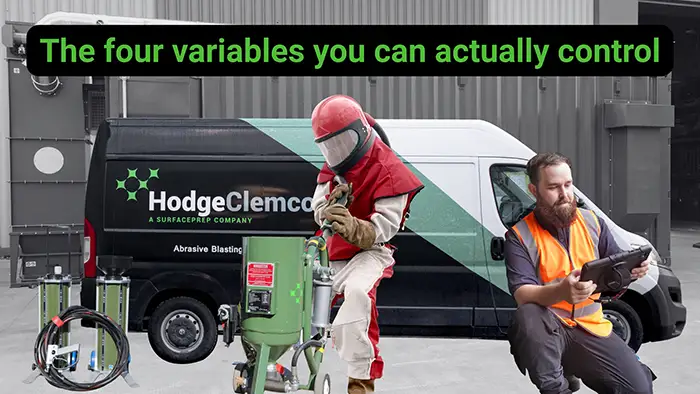
The four controllable variables and what you need to change for your operation.
1. Blast time per part
What it is
The actual time it takes to achieve the required cleanliness, profile or finish on each part.
Why it affects cost per part
Blast time is where labour, machine availability, energy use and throughput all converge. If blast time drifts up, cost per part rises even when nothing obvious has changed on the purchase ledger.
Common causes of waste or inefficiency
Blast time usually stretches because of process drift, not one dramatic failure. Common causes include worn nozzles, poor pressure control, inconsistent media flow, poor visibility, unstable air supply, and operators compensating for equipment that is no longer performing consistently. We advise all customers to run routine checks on nozzles, blast hoses, holders, gaskets and metering valves, and ensure your nozzles are replaced when the internal diameter has worn 1.5 mm beyond its original size.
Practical examples of what does go wrong
A process that used to hit the target in one pass starts taking longer. The operator stands closer, stays longer on edges, or increases pressure to recover cutting speed. The work still gets done, but the real cost per part has already moved.
Our article on nozzle-efficiency makes this point clearly (you can read it here ). As the nozzle wears, the orifice opens up, air and abrasive consumption rise, and the blast pattern becomes less controlled. The process becomes more expensive, unpredictable, and produces a worse result.
What good control looks like
- Treat nozzle condition as a throughput variable, not just a consumable issue
- Check wear before the process quality starts drifting
- Standardise pressure, standoff distance, dwell time and media settings for repeat jobs
- Use maintenance checks as a production control routine, not just a safety exercise
2. Compressed air efficiency and availability
What it is
The quality, volume and stability of air available at the nozzle, not just the rated output of the compressor on paper.
Why it affects cost per part
Compressed air is one of the biggest hidden cost drivers in blasting. If supply is inadequate or unstable, the process slows, finish consistency suffers, and operators compensate in ways that increase consumption elsewhere.
SurfacePrep’s air consumption chart highlights that consumption depends on the nozzle. In addition, small changes in nozzle size can create large changes in running costs, and that an undersupplied nozzle leads to instability, inconsistent finish and more touch-up.
Common causes of waste or inefficiency
- Nozzle size does not match true available air supply
- Pressure loss through worn hoses, valves or couplings
- Worn nozzles increasing CFM demand
- Water or contamination in the air line
- Extraction or room airflow issues affecting visibility and working conditions
Good maintenance guidance is to inspect hoses, couplings, gaskets, water separators and metering valves for wear or leaks, because these issues affect both safety and performance.
Practical examples of what goes wrong
A team installs a larger nozzle to speed up blasting, but the real delivered air cannot support it. Pressure becomes unstable, finish quality drifts, and touch-up rises. The job feels more aggressive, but real throughput does not improve in proportion to the extra air and media being consumed.
What better control looks like
- Match nozzle size to confirmed delivered air at the nozzle
- Actual nozzle pressure checks (Hypodermic needle gauge)
- Inspect and replace worn hoses, couplings and seals before they create pressure loss
- Monitor air quality and filtration, especially where breathing air and process stability matter
- Treat compressor capacity, nozzle choice and hose condition as one system
3. Media consumption and media choice
What it is
Not just how much abrasive you buy, but how much useful work each kilogram of media does before it becomes waste.
Why it affects cost per part
Media consumption is influenced by nozzle size, pressure, wear, recovery efficiency, contamination, breakdown rate and whether the abrasive is right for the application. That means two sites can spend the same amount per tonne and get very different output.
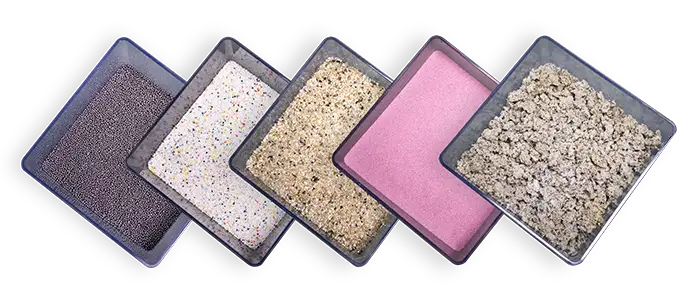
SurfacePrep offers a range that spans recyclable and expendable media, and cabinet and sample-processing content emphasises the importance of matching abrasive type to application and machinery before purchase. To push standards higher, adding recovery, regrading and recycling systems as part of process efficiency makes for even stronger control over costs.
Common causes of waste or inefficiency
- Running the wrong abrasive for the surface or required finish
- Over-feeding media through poor metering control
- Using worn nozzles that pull more abrasive through the system
- Poor recovery or separation, so reusable media is lost with fines and contamination
- Dust extraction performance that allows the process to deteriorate
Dust extraction is integral to any blasting system and is a warning that cost cutting at this point leads to reduced efficiency, early failure, and is ultimately a false economy as you pay more in the long term. A properly designed separation and recovery system will improve process reliability and allow a wide range of media to be cleaned effectively. You can talk to our engineers at any time.
Practical examples of what goes wrong
A site blames abrasive price, when the real issue is that contaminated or badly controlled media is no longer cutting consistently. Operators respond by opening the metering valve further, which increases usage without solving the underlying problem.
4. Rework, inconsistency and avoidable process loss
What it is
Any additional time, labour or delay caused by parts not meeting the required standard first time.
Why it affects cost per part
Rework is where hidden cost becomes most painful. It consumes labour twice, disrupts schedules, blocks downstream operations and often masks the real source of instability.
Common causes of waste or inefficiency
- Inconsistent nozzle pressure
- Worn nozzle or poor blast pattern
- Inappropriate media choice
- Weak visibility caused by poor extraction
- Operator variation
- Lack of standard settings and maintenance discipline
SurfacePrep runs a full service and training programme which has been built around this reality, and our engineers experience the impact of this every day. There is a clear link between downtime to customers “chasing” production targets, pushing the system to the edge. Our growing training offer covers blast room operations, pot maintenance, cabinet maintenance, PPE/RPE and fault finding, which is exactly where variation and avoidable loss appear. All these issues are avoidable if you plan. Or consider getting service cover or training from our experts.
Practical examples of what goes wrong
A part comes out looking acceptable to one operator but fails inspection later because profile or cleanliness is inconsistent. The re-blast may only take a few more minutes, but the true costs include queue disruption, handling, inspection time and schedule knock-on.
What better control looks like
- Standard operating settings by job type
- Routine nozzle and metering checks
- Training that reduces operator compensation and guesswork
- Preventive servicing aimed at stability, not just breakdown response
The compound effect of slipping costs
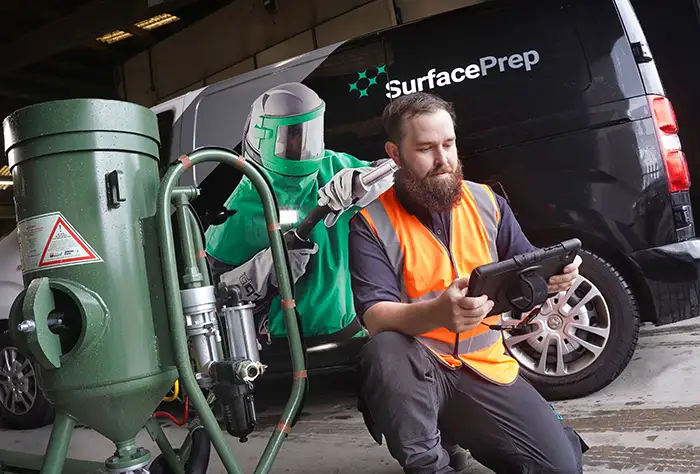
A part many businesses underestimate. A slightly worn nozzle increases air demand and media pull. A small pressure loss slows blasting. Reduced visibility makes the operator spend longer on the part. Process inconsistency creates touch-up. None of these losses looks dramatic on its own. Together, they can shift cost per part significantly.
SurfacePrep fully endorses customers adopting a system view. It is no surprise that maintenance is directly linked to reliability, efficiency, safety, quality and profitability. Poor dust extraction leads to poor collector choice which reduces efficiency and can shorten system life. Worn nozzles increases air and abrasive consumption and reduce control.
This is why blasting cost control is rarely won by buying cheaper media. It is won by stabilising the process with a comprehensive system.
Ending with a proof point
A useful technical example from BlastOne’s explanation of worn venturi nozzles. As the nozzle bore enlarges, blasting speed falls, airflow rises, more abrasive is drawn through the metering valve, and pressure loss through the system increases. Therefore, abrasive velocity falls from about 450 mph to about 215 mph as the venturi wears, while pressure loss can increase by 10 to 15 psi in longer hose setups.
You do not need to accept every number as universal to see the operational lesson. A relatively small wear issue at the nozzle can hit all four cost variables at once, time per part, air, media and rework risk.
Download The Checklist
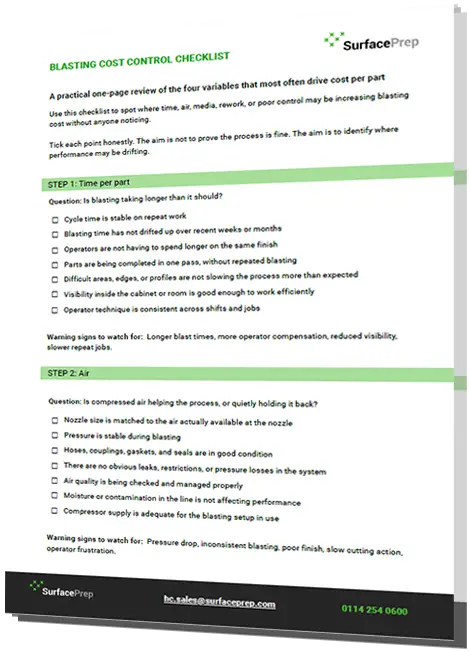
If you want a simple way to review where costs may be leaking from your blasting process, download the checklist. It gives your team a one-page framework to assess the variables that most often drive up cost per part:
- time per part
- air
- media
- rework
No formulas. No spreadsheet. Just a practical way to spot where the process is becoming slower, less stable, or more expensive than it should be.