
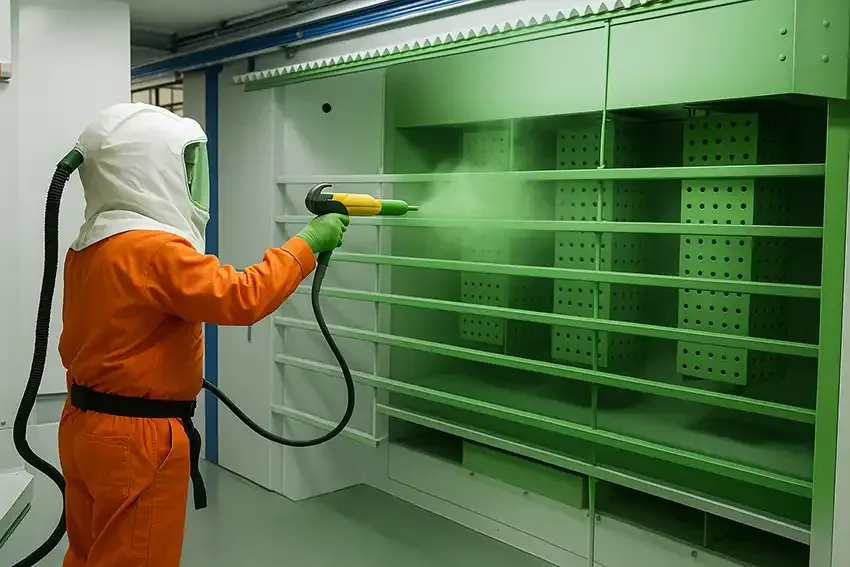
Surface preparation before coating is the stage that creates the surface condition needed for paint or powder to perform as intended. Applying a high-quality coating to a poorly prepared substrate can still result in adhesion problems, premature corrosion, inconsistent appearance and avoidable rework.
The correct preparation depends on the substrate, existing surface condition, coating system, required performance and production environment. Abrasive blasting may form part of the solution, while other applications require cleaning, degreasing, chemical pre-treatment or a combination of preparation methods.
Why is surface preparation important before coating?
A coating needs to be applied to a surface that meets the requirements of the coating specification.
Contamination such as oil, grease, rust, scale, old coating residues and dust can interfere with adhesion or create defects beneath the new coating. The surface may also need a defined profile so the coating can bond effectively to the substrate.
This is why coating performance starts before the spray gun or powder booth.
SurfacePrep's existing coating guidance identifies inadequate preparation as one of the common causes of poor adhesion, uneven coating and reduced durability.
Abrasive blasting before painting or coating
Abrasive blasting can remove corrosion, mill scale, existing coatings and other firmly attached contamination while also producing a controlled surface profile.
The required blasting process depends on the component and specification. Large steel fabrications may be processed in a blast room, smaller components in cabinets, while structures and maintenance work may require portable blasting equipment.
The objective is not simply to make the surface look clean. Abrasive blast cleaning needs to achieve the cleanliness and profile required by the coating system that follows.
The abrasive, particle size, blasting parameters and starting condition of the substrate all influence the result.
Cleaning and chemical pre-treatment
Abrasive blasting is not the only preparation stage used before coating.
Oil, grease and other contaminants may require cleaning or degreasing, while many powder coating operations incorporate pre-treatment systems before powder is applied.
SurfacePrep's current systems can include multi-stage wash and rinse processes, chemical treatment and drying. Treatment may include phosphating or other conversion processes depending on the material and required performance.
The sequence should be designed around the substrate, coating specification and production requirement rather than adopting a standard treatment simply because it has been used previously.
Cleanliness and surface profile
Surface preparation needs a measurable endpoint.
For blasted steel, surface cleanliness and profile can be compared against recognised requirements. SurfacePrep's Standards of Surface Finish guidance explains the relationship between initial steel condition, blasting and the resulting surface.
The required profile should be matched to the coating system. Too little profile may not provide the required surface condition, while unnecessarily aggressive preparation can create its own problems and increase abrasive consumption.
Coating manufacturers and project specifications should therefore determine the required preparation standard.
Preparing surfaces for powder coating
Powder coating is not simply a powder application process.
The complete production route can include preparation, pre-treatment, drying, powder application and curing.
SurfacePrep's powder coating systems can combine pre-treatment equipment, dry-off and curing ovens, powder booths, conveyors and controls into a connected production system.
A recent SurfacePrep installation for Debar demonstrates this principle. Its automated coating line begins with a five-stage pre-treatment process designed to clean and condition aluminium components before powder application and controlled curing.
The commercial benefit of considering these stages together is consistency. Preparation, coating and curing need to operate at compatible production rates if the line is to deliver repeatable output without creating bottlenecks.
Preparing surfaces for wet paint
The same principle applies to industrial wet coating.
Once the required surface condition has been achieved, the coating needs to be applied under controlled conditions using equipment suited to the coating and production requirement.
SurfacePrep supplies wet paint finishing systems, including dry-filter and water-wash spray booths, together with application equipment for industrial coatings.
For protective coatings applied on site or in demanding industrial environments, SurfacePrep also supplies coating application equipment, including electric and pneumatic airless systems.
This means the preparation and application stages can be considered as one production problem rather than separate equipment purchases.
From blasting to coating as one system
The strongest surface finishing process is not necessarily the one with the most sophisticated blast machine or coating booth. It is the one where each stage delivers what the next stage requires.
That can mean considering:
surface condition → preparation → cleaning/pre-treatment → inspection → coating application → drying or curing
SurfacePrep has already delivered installations that combine blast preparation and painting equipment within the same material-handling process, including blast rooms, abrasive recovery and dry-filter spray booths.
This is where SurfacePrep's wider capability becomes commercially important. The same technical conversation can consider the condition of the incoming component, how it should be prepared, how the coating will be applied and how the finished component needs to leave the line.
Choosing the right preparation and coating process
Before equipment is specified, SurfacePrep can assess the substrate, surface condition, contamination, required coating performance, component size, production volume and available space.
From there, blasting, pre-treatment, coating application and curing equipment can be considered as parts of one process.
Talk to SurfacePrep about your surface preparation and coating requirement.