
A clear checklist to protect your people, prove your controls, and protect uptime
Introduction
Over the last 8 weeks, we’ve published a number of practical guides designed to help you, manufacturers and engineers to stop downtime stealing your throughput. Not by chasing quick fixes, but by tightening the everyday controls that keep lines running, keep operators protected, and keep your evidence for when auditors call.
Downtime in abrasive blasting rarely arrives as one big failure. It shows up as repeat stoppages, rising spares spend, creeping cycle times, and operators working around kit that no longer feels right for the conditions. It also shows up in scrutiny, customer questions, audits, and internal safety reviews, when you need to prove that your controls were in place and working.
This guide pulls together the practical system we’ve been building over the last eight weeks into one usable framework you can apply on site. It is written for Operations, Engineering, Maintenance, Production, HSE, and Procurement teams who need fewer surprises and more control.
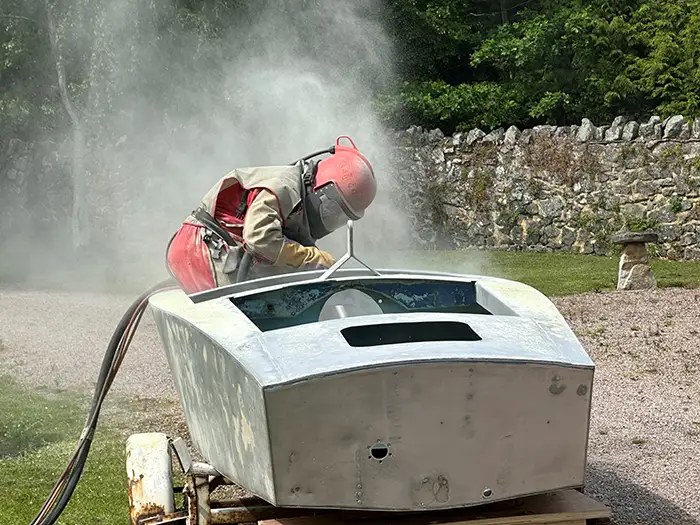
Why abrasive blasting downtime is usually a systems problem
A common mistake is treating downtime as a repair problem or treating PPE as a shopping list. Both approaches miss the root cause. Abrasive blasting relies on a small number of controls working together, consistently:
- Operator protection systems that actually work in live conditions
- Verification (tests, checks, records) that stands up under pressure
- Predictable maintenance, spares planning, and early warning on wear and drift
If one link is weak, performance degrades quietly until it becomes a stop.
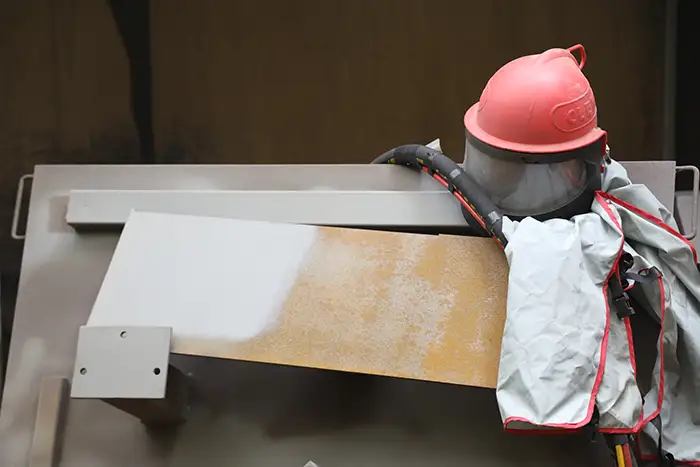
Treat your PPE as a system, not isolated kit components
One of the biggest failure points our engineers see, is PPE being treated as individual items:
- A helmet
- A suit
- A filter
- A hose
- A nozzle
In reality, blasting PPE only protects the operator when the whole system is correct, maintained, and verified.
A practical PPE system view includes:
- Helmet and visor condition, visibility, sealing, impact protection
- Breathing air supply, air quality, correct filtration, correct setup
- Air fed suitability, the setup fits the environment, heat, dust load, job duration
- Suit, gloves, and consumables, condition, fit, replacement rhythm
- Extraction and LEV performance, dust control in the real operating state
- Checks, maintenance, and records, proof that controls were in place when it mattered
If you take one idea from this article, take this: PPE is not what you buy, it’s what you can reliably run, check, and evidence.
Read the deeper guidance:
Then tighten one of the most overlooked weak links:
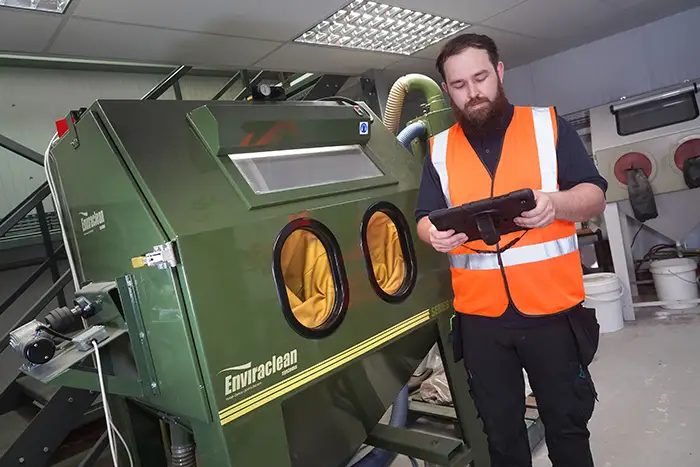
The take-away framework: Protect people, Prove controls, Protect uptime
This framework is designed for real sites. It is simple enough to use, but strict enough to stop drift.
1) Protect people
Blasting conditions change fast. Dust load, ricochet, noise, heat stress, and airflow performance can swing with the job and with equipment condition. “Looks fine” is not a control.
Practical focus areas:
- PPE is set up correctly, maintained, and replaced to a defined rhythm
- Breathing air is treated as a critical control, not an assumption
- Operators have a clear route to raise concerns, and those concerns trigger action
If you want operator protection to hold under pressure, the system has to work on a bad day, not just a good one.
2) Prove controls
This is where many businesses are exposed. They may be doing the right things, but cannot prove it quickly, or cannot prove it consistently across sites.
“Prove” means tests, checks, and records that stand up to scrutiny. Two key verification themes:
- Blast machine inspection with an MOT mindset, routine checks that verify safety controls are working, not just that the machine is running
- LEV testing and extraction verification, because extraction performance must be measured in the real operating state, especially when usage patterns change
If your first reaction is “we do most of that, but it’s scattered”, that is the risk. The problem is rarely that nothing happens, it is that it is inconsistent, undocumented, or hard to retrieve when it matters.
3) Protect uptime
Uptime protection is not only fast repair response. It is stopping predictable failure points from turning into stoppages, and removing slow leaks in performance that quietly steal throughput.
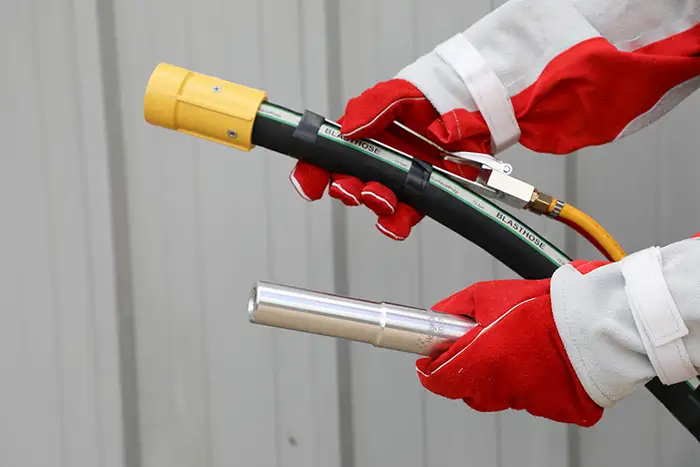
A classic example is nozzle wear and blast efficiency drift. Orifice wear can reduce cutting performance, stretch cycle times, and increase air and abrasive consumption. That is not a dramatic failure, but it is downtime in disguise.
Start here:
Abrasive blasting downtime checklist you can use immediately
Use this as a simple on site rhythm. The objective is consistency, not heroics.
What to check weekly
- Visual condition checks on helmets, visors, suits, gloves, hose connections
- Operator feedback logged, especially visibility, breathing comfort, dust conditions
- Quick “does this still work in real conditions?” check on extraction performance
- Nozzle condition and blast performance check, watch for creeping cycle time
What to verify monthly or quarterly
- Breathing air quality checks in line with your risk profile and usage, and ensure results are recorded and retrievable
- LEV performance verification, with remedial actions documented
- Spares and consumables review, identify items driving repeat orders and unplanned stops
- “Top 5 downtime causes” review, confirm each has a prevention control, not just a repair plan
What to schedule annually
- Formal machine inspection and verification cycle using an MOT mindset
- Documented review of blasting safety controls, including what changed over the year
- Refresh of standard operating checks and records, especially across multi site operations
What evidence to keep for audits and customer scrutiny
- Breathing air test results and dates, plus corrective actions
- LEV test results and follow ups
- Machine inspection records, service actions, safety control verification
- PPE inspection and replacement logs
- Downtime incidents, root cause notes, and what changed to prevent repeat events
Proof in practice: two recent examples
Sometimes the easiest way to create internal buy in is to show what “system thinking” looks like when applied.
- Falcon Tower Cranes spray and bake container case study
A finishing process improvement story that focuses on reliability and process confidence, not just equipment. - TotalCare case study: unfamiliar breakdown downtime resolved in 2 hours
When an unfamiliar breakdown hits, diagnosis speed and access to the right support reduces time to recovery.
Forward this to the right people
If you want this to turn into action, send it to the people who control the levers:
- Ops, reduce unplanned stops and protect throughput without relying on heroics
- Maintenance, standardise checks, spares planning, and service rhythm across sites
- HSE, strengthen the “prove it” side of operator protection, air quality, extraction, records
- Procurement, move from urgent buying to planned stocking and verified replacements
Get a TotalCare Uptime Review
If you want help turning this into a consistent system across your site, the fastest next step is a TotalCare Uptime Review.
What it is: a low friction diagnostic call to map your downtime risks, compliance gaps, and spares exposure, then recommend the right next steps.
Who it’s for:
- Multi site teams trying to standardise servicing, spares, and evidence
- Sites with recurring stoppages, rising spares spend, or creeping performance loss
- Teams under audit pressure or increased customer scrutiny
- Operations where operators have raised concerns about air, extraction, or PPE suitability
What happens in the review (high level):
- You outline your current setup, failure patterns, and risk areas
- We review what is being checked, tested, and recorded, and what is missing
- We identify priority actions that protect people, prove controls, and protect uptime
- We recommend the most sensible next steps based on your situation
What you get out of it:
- A clear set of priorities, not a long wish list
- Recommended checks and verification actions to reduce risk and prevent repeat downtime
- Practical next steps you can take internally, or with support from SurfacePrep
Talk to an engineer
If you have a specific issue to solve, recurring nozzle wear, breathing air concerns, extraction performance, unexplained stoppages, talk to an engineer about your specific issue and we’ll help you get to the root cause and the right fix.
FAQs
How do you reduce downtime in abrasive blasting?
Reduce downtime by treating blasting as a control system: protect operators with verified PPE and breathing air, prove controls with tests and records, and protect uptime with planned maintenance, spares planning, and early detection of wear and performance drift.
What is breathing air testing for air fed blasting helmets?
Breathing air testing checks that the air supplied to an air fed helmet is safe and meets required quality criteria. Many sites reference EN 12021 as the benchmark for breathing air quality.
Why does LEV testing matter for blasting operations?
LEV testing verifies that extraction is performing as required in real operating conditions. Extraction performance can change as dust burden, usage patterns, and system condition change.
Keep retrievable evidence of breathing air tests, LEV verification, machine inspection and safety control checks, PPE inspection and replacement logs, and downtime incidents with root cause and corrective actions.
How do you spot nozzle wear before it causes downtime?
Watch for creeping cycle time, reduced cutting performance, and changes in air and abrasive consumption. Nozzle wear often looks like gradual performance drift before it becomes a problem.